

Samuel Adams, born SEPTEMBER 27, 1722, was known as "The Father of the American Revolution."

 Spreading the slogan "No taxation without representation," Sam Adams instigated the Stamp Act Riots in 1765 against the overreaching British government.


"Government has no right to absolute, arbitrary power over the lives and fortunes of the people; nor can mortals assume a prerogative (exclusive right) ... reserved for the exercise of the Deity alone."
This echoed the 1750 sermon of Boston Pastor Jonathan Mayhew:
"As soon as the prince sets himself up above law, he loses the king in the tyrant: he does to all intents and purposes, unking himself ... and, therefore, to resist him, was no more rebellion, than to oppose any foreign invader."


When it first met, September 6, 1774, a motion was made to open with prayer, despite delegates being from different Christian denominations:
"It did not become men, professing to be Christian men, who had come together for solemn deliberation in the hour of their extremity, to say there was so wide a difference in their religious belief that they could not, as one man, bow the knee in prayer to the Almighty, whose advice and assistance they hoped to obtain."
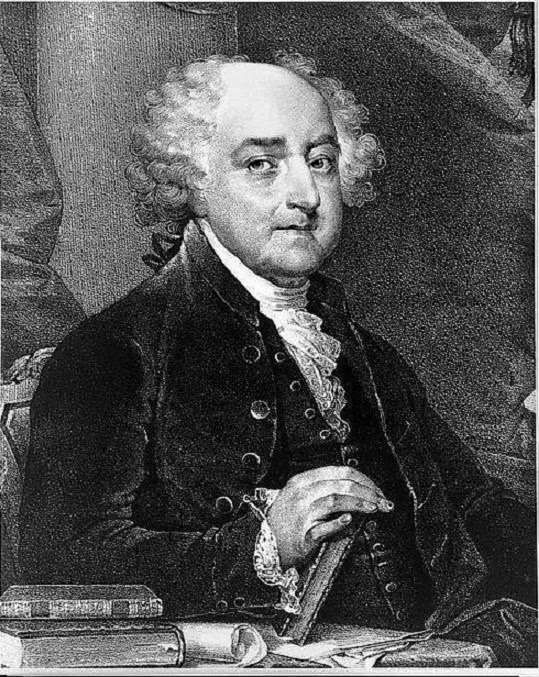

"When the Congress met, Mr. Cushing made a motion that it should be opened with Prayer.
It was opposed by Mr. Jay of New York, and Mr. Rutledge of South Carolina because we were so divided in religious sentiments, some Episcopalians, some Quakers, some Anabaptists, some Presbyterians, and some Congregationalists, that we could not join in the same act of worship.
Mr. Samuel Adams arose and said that he was no bigot, and could hear a Prayer from any gentleman of Piety and virtue, who was at the same time a friend to his Country.
He was a stranger in Philadelphia, but had heard that Mr. Duche' (Pastor of Christ Episcopal Church, Philadelphia), deserved that character and therefore he moved that Mr. Duche', an Episcopal clergyman might be desired to read Prayers to Congress tomorrow morning.
The motion was seconded, and passed in the affirmative."
In 1750, Samuel Adams wrote:
"He therefore is the truest friend to the liberty of his country who tries most to promote its virtue, and who, so far as his power and influence extend, will not suffer a man to be chosen into any office of power and trust who is not a wise and virtuous man ....
The sum of all is, if we would most truly enjoy this gift of Heaven, let us become a virtuous people."
Samuel Adams gave advice to T. Wells, his daughter's fiancee, November 22, 1780:
"I could say a thousand things to you, if I had leisure. I could dwell on the importance of piety and religion, of industry and frugality, of prudence, economy, regularity and even Government, all of which are essential to the well being of a family. But I have not time.
I cannot however help repeating piety, because I think it indispensable. Religion in a family is at once its brightest ornament and its best security."

Gage attempted to intimidate Samuel Adams into giving up.
Adams dictated a message to be delivered to General Gage:
"I trust I have long since made my peace with the King of Kings. No personal consideration shall induce me to abandon the righteous cause of my country.
Tell Governor Gage it is the advice of Samuel Adams to him no longer to insult the feelings of an exasperated people."
 Paul Revere rode to warn the colonists that British General Thomas Gage was marching with 700 soldiers on April 18, 1775, to take the colonists' guns and arrest John Hancock and Samuel Adams.

After the British evacuated Boston, Samuel Adams wrote from Philadelphia to James Warren, April 16, 1776:
"I have not yet congratulated you in the unexpected and happy change of our affairs in the removal of the rebel army from Boston ...
It becomes us to rejoice and religiously to acknowledge the goodness of the Supreme Being who in this instance hath signally appeared for us ....
They have attempted to subdue us by force, but God Be praised, in vain."
 Sam Adams stated after signing the Declaration:
"We have this day restored the Sovereign to Whom all men ought to be obedient. He reigns in heaven and from the rising to the setting of the sun, let His kingdom come."
He address the delegates in the State House in Philadelphia, August 1, 1776:
"This day, I trust, the reign of political protestantism will commence.
We have explored the temple of royalty, and found that the idol we have bowed down to, has eyes which see not, ears that hear not our prayers, and a heart like the nether millstone.
We have this day restored the Sovereign, to whom alone all men ought to be obedient. He reigns in Heaven, and with a propitious eye beholds his subjects assuming that freedom of thought, and dignity of self-direction which He bestowed on them ...
We are now on this continent to the astonishment of the world three millions of souls united in one common cause ..."
Adams continued:
"There are instances of, I would say, an almost astonishing Providence in our favor;
our success has staggered our enemies, and almost given faith to infidels; so that we may truly say it is not our own arm which has saved us.
The hand of Heaven appears to have led us on to be, perhaps, humble instruments and means in the great Providential dispensation which is completing ..."
 He concluded:
"We have fled from the political Sodom; let us not look back, lest we perish and become a monument of infamy and derision to the world! ...
And, brethren and fellow-countrymen, if it was ever granted to mortals to trace the designs of Providence, and interpret its manifestations in favor of their cause, we may, with humility of soul, cry out, "Not unto us, not unto us, but to thy Name be the praise."
The confusion of the devices among our enemies, and the rage of the elements against them, have done almost as much towards our success as either our councils or our arms ...
These are all strong and palpable marks and assurances, that Providence is yet gracious unto Zion, that it will turn away the captivity of Jacob.
Our glorious reformers, when they broke through the fetters of superstition, effected more than could be expected from an age so darkened.
But they left much to be done by their posterity.
They lopped off, indeed, some of the branches ... but they left the root and stock when they left us under the domination of human systems and decisions, usurping the infallibility which can be attributed to Revelation alone.
They dethroned one usurper only to raise up another ....
And if we now cast our eyes over the nations of the earth we shall find, that instead of possessing the pure religion of the gospel, they may be divided either into infidels who deny the truth, or politicians who make religion a stalking horse for their ambition, of professors, who walk in the trammels of orthodoxy, and are more attentive to traditions and ordinances of men than to the oracles of truth.
Thus by the beneficence of Providence, we shall behold our empire arising, founded on justice and the voluntary consent of the people, and giving full scope to the exercise of those faculties and rights which most ennoble our species.
Besides the advantages of liberty and the most equal constitution, Heaven has given us a country with every variety of climate and soil, pouring forth in abundance whatever is necessary for the support, comfort, and strength of a nation ...
Go on, then, in your generous enterprise, with gratitude to Heaven for past success, and confidence of it in the future.
For my own part, I ask no greater blessing than to share with you the common danger and common glory."

After the public reading of the Declaration of Independence, Samuel Adams noted:
"The people, I am told, recognize the resolution as though it were a decree promulgated from Heaven."
Ronald Reagan stated in 1961:
"In this country of ours took place the greatest revolution that has ever taken place in the world's history. Every other revolution simply exchanged one set of rulers for another.
Here for the first time in all the thousands of years of man's relation to man ... the founding fathers established the idea that you and I had within ourselves the God-given right and ability to determine our own destiny."
 Sam Adams wrote in The Rights of Colonists, 1772:
"Among the natural rights of Colonists are:
FIRST, a right to life;
SECONDLY, to liberty;
THIRDLY, to property;
together with the right to defend them ...
The supreme power cannot justly take from any man any part of his property without his consent."
 In The Rights of the Colonists, section "The Rights of the Colonist as Men," Samuel Adams wrote:
"In regards to religion, mutual toleration in the different professions thereof is what all good and candid minds in all ages have ever practiced ...
and it is now generally agreed among Christians that this spirit of toleration, in the fullest extent consistent with the being of civil society, is the chief characteristical mark of the church."

"The right to freedom being the gift of God Almighty, the rights of the Colonists as Christians may best be understood by reading and carefully studying the institutions of The Great Law Giver and the Head of the Christian Church, which are to be found clearly written and promulgated in the New Testament."

"Revelation assures us that 'Righteousness exalteth a nation' ... Communities are dealt with in this world by the wise and just Ruler of the Universe. He rewards or punishes them according to their general character ...
Public liberty will not long survive the total extinction of morals.
'The Roman Empire,' says the historian, 'must have sunk, though the Goths had not invaded it. Why? Because the Roman virtue was sunk.'
Could I be assured that America would remain virtuous, I would venture to defy the utmost efforts of enemies to subjugate her."
 Samuel Adams was elected as Governor of Massachusetts, and wrote to James Warren, February 12, 1779, warning:
"A general dissolution of the principles and manners will more surely overthrow the liberties of America than the whole force of the common enemy.
While the people are virtuous they cannot be subdued;
but once they lose their virtue, they will be ready to surrender their liberties to the first external or internal invader."
 Samuel Adams warned:
"Neither the wisest constitution nor the wisest laws will secure the liberty and happiness of a people whose manners are universally corrupt."
On March 20, 1797, in a Proclamation of a Day of Fast, Massachusetts Governor Samuel Adams declared::
"Humbly supplicating the Supreme Ruler of the world that the rod of tyrants may be broken to pieces, and the oppressed made free again;
that wars may cease in all the earth, and that the confusions that are and have been among nations may be overruled by promoting and speedily bringing on that holy and happy period when the kingdom of our Lord and Saviour Jesus Christ may be everywhere established,
and all people everywhere willingly bow to the sceptre of Him who is Prince of Peace."
-

American Minute is a registered trademark of William J. Federer. Permission granted to forward, reprint, or duplicate.