
LISTEN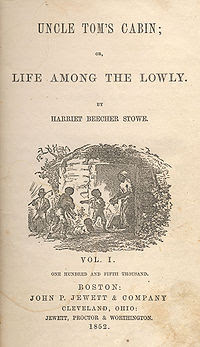 Download as PDF ...
Harriet Beecher Stowe wrote the anti-slavery novel Uncle Tom's Cabin.
Published first in serial form between 1851-52, the book gained international fame and greatly stirred up support for the abolitionist movement.
It was the second best-selling book of the 19th century, after the Holy Bible.
It sold 10,000 copies in America the first week it was published, and 300,000 the first year.
In England, it sold over 1.5 million copies.
 President Lincoln met Harriet Beecher Stowe on December 2, 1862.
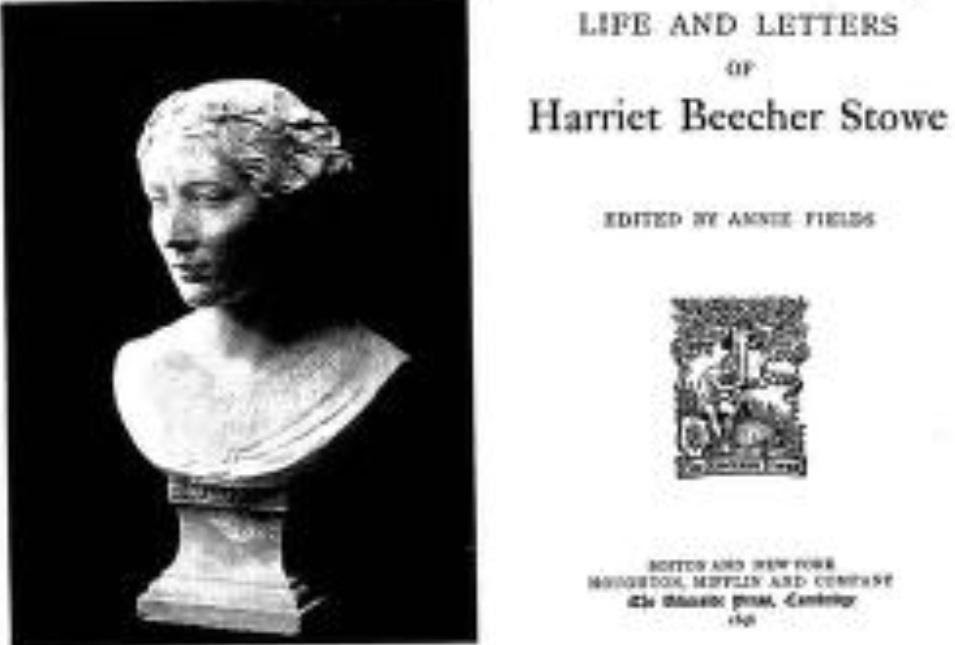
The Atlantic Monthly published an account written in 1896 by Annie Fields, wife of the magazine's publisher James T. Fields, who wrote in her biography of Stowe:
"It was left for others to speak of her interview with President Lincoln. Her daughter was told that when the President heard her name he seized her hand saying, 'Is this the little woman who made the great war?'"
 Stowe wrote of her visit with Lincoln in The Watchman and Reflector, recalling him saying:
"Whichever way it ends, I have the impression that I sha'n't last long after it's over."
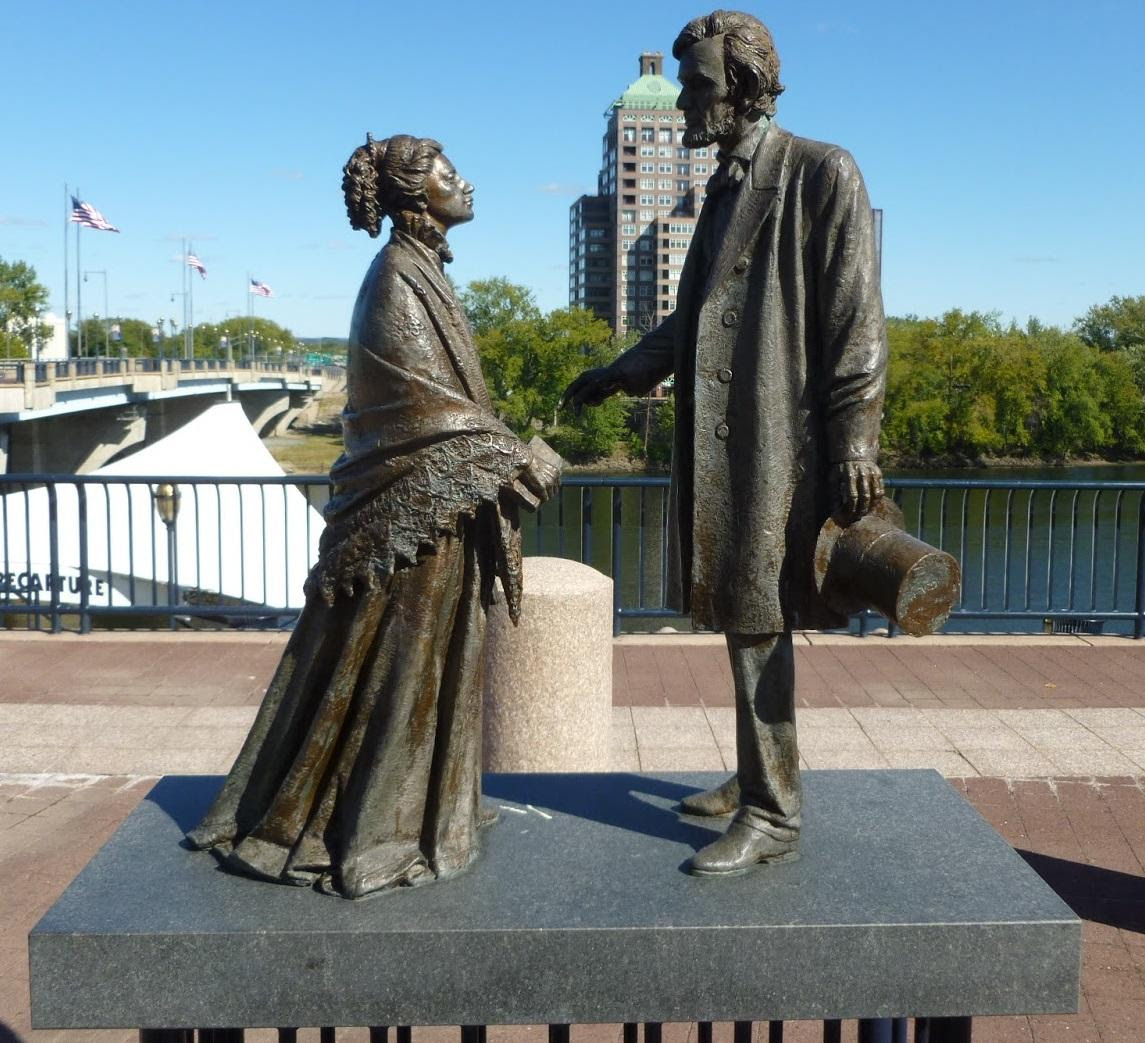
A statue in Hartford, Connecticut, commemorates the meeting of Lincoln and Stowe.
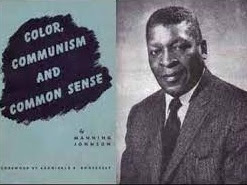
"In their usual diabolically clever way, the reds took the name of a fine, sincere and beloved character made famous in the greatest indictment of chattel slavery (Uncle Tom's Cabin) and transformed him into a “dirty, low, sneaky, treacherous, groveling, snivering coward.”
This the reds did in order to make the name “Uncle Tom” the symbol of social, economic and political leprosy ... turning many ministers into moral cowards, many politicians into scared jackrabbits ... No man dare stand up and proclaim convictions counter to red agitation without running the certain risk of being pilloried."
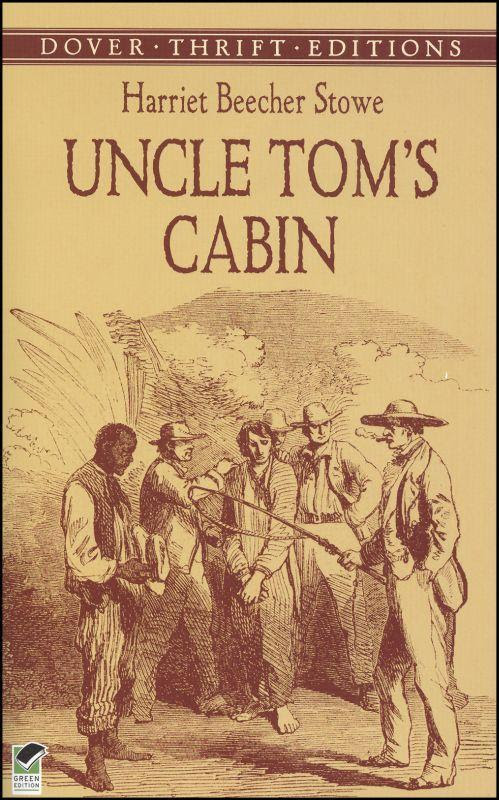
Harriett Beecher Stowe's book ends by saying:
"A day of grace is yet held out to us.
Both North and South have been guilty before God; and the Christian church has a heavy account to answer.
Not by combining together, to protect injustice and cruelty, and making a common capital of sin, is this Union to be saved, but by repentance, justice and mercy."
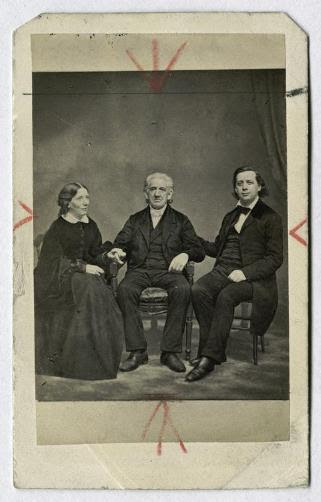 Harriet Beecher Stowe was the daughter of the famous New England minister Lyman Beecher.
Her seven brothers were all ministers, the most renowned being the Rev. Henry Ward Beecher, one of the most popular preachers in American in the middle 1800s.
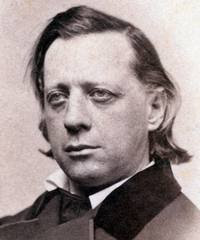
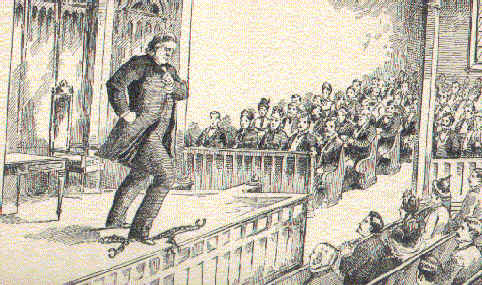 Beecher purchased the chains that held abolitionist John Brown in prison, even dragging them across the platform and stomping on them as he preached against slavery.
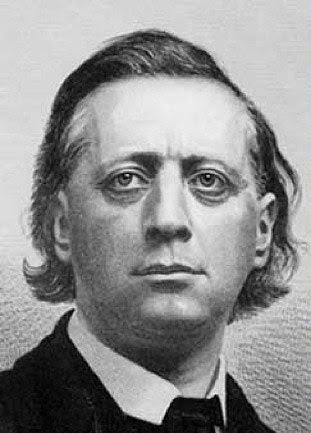 Thousands attended Beecher's enormous Plymouth Church in Brooklyn, New York, including Abraham Lincoln, Walt Whitman and Mark Twain.
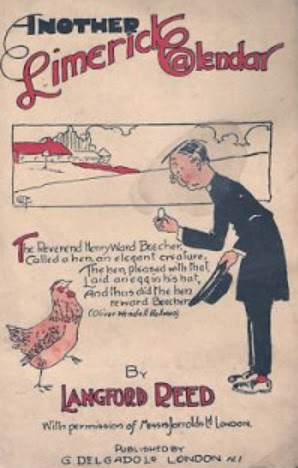 Oliver Wendell Holmes, Sr., wrote a limerick about Henry Ward Beecher.
"The Reverend Henry Ward Beecher,
Called a hen an elegant creature,
The hen, pleased with that,
Laid an egg in his hat,
And thus did the hen reward Beecher."
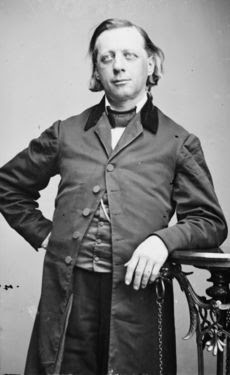 In 1863, Beecher visited England and Scotland.
He lectured about the American Civil War, which helped erode British support for the Confederate South.
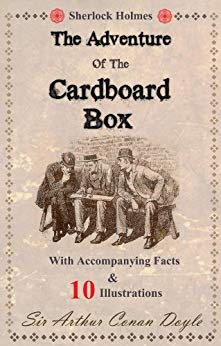 The British novelist, Sir Arthur Conan Doyle, mentioned this in his Sherlock Holmes mystery "The Cardboard Box," 1893:
"Your eyes flashed across to the unframed portrait of Henry Ward Beecher which stands upon the top of your books ...
Your thoughts went back to Beecher, and you looked hard across as if you were studying the character in his features. ...
You were recalling the incidents of Beecher's career. I was well aware that you could not do this without thinking of the mission which he undertook on behalf of the North at the time of the Civil War."
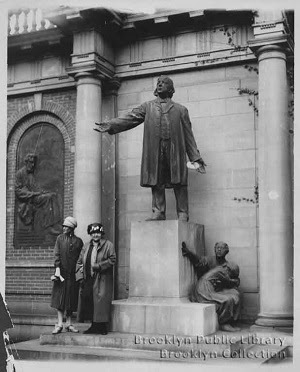 Gutzon Borglum, creator of Mount Rushmore, sculpted a statue of him.
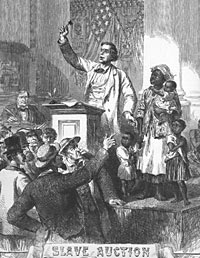 One young slave girl, Pinky, was actually liberated by Beecher's congregation which collected her purchase price of $900.

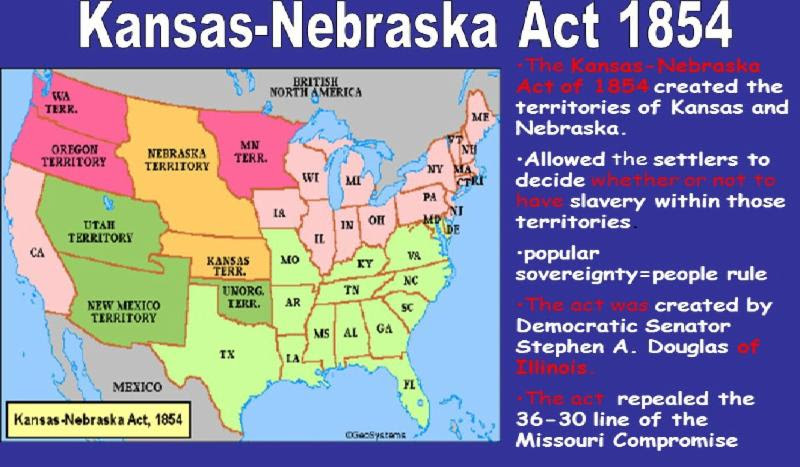 Prior to the Civil War, the Kansas-Nebraska Act let the issue of slavery be determined by the "choice" of the people in the Kansas territory by popular sovereignty.

Many of the Lincoln-Douglas debates were on this topic.
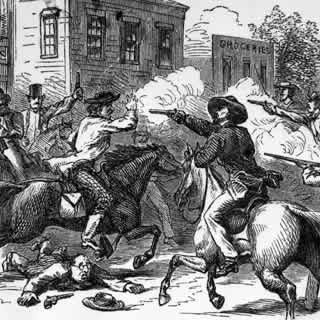
Soon, a rush of pro-slavery Democrat "Border Ruffians" flooded into Kansas, unleashing a wave of bloody violence.
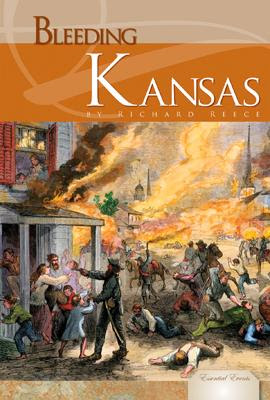 The territory was referred to as "Bleeding Kansas."
Two different Kansas state legislatures were organized:
- a Pro-slavery government met in Pawnee;
and
- an Anti-slavery "Free State" government met in Topeka.
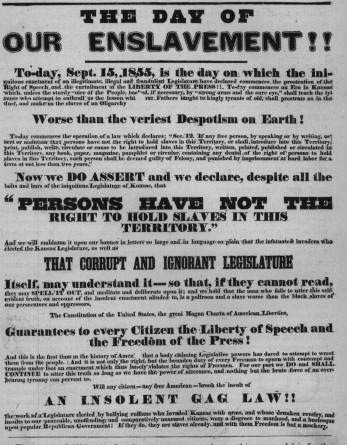 The anti-slavery "Free-Staters" accused the pro-slavery Democrats as holding a Bogus Legislature.
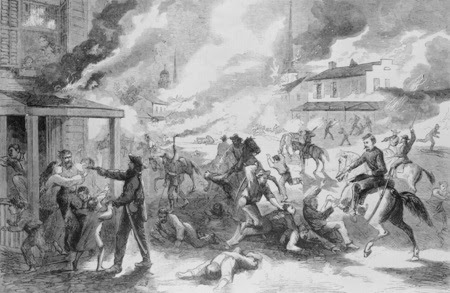
Starting off as just organized riots, the situation quickly escalated into blood-shed and violent atrocities:
- The Wakarusa War started in November of 1855.
- Lawrence, Kansas, was ransacked on May 21, 1856, and later massacred by Quantrill's Raiders
- Pottawatomie Massacre, May 24, 1856.
- Battle of Black Jack, June 2, 1856.
- Battle of Fort Titus, August 16, 1856,
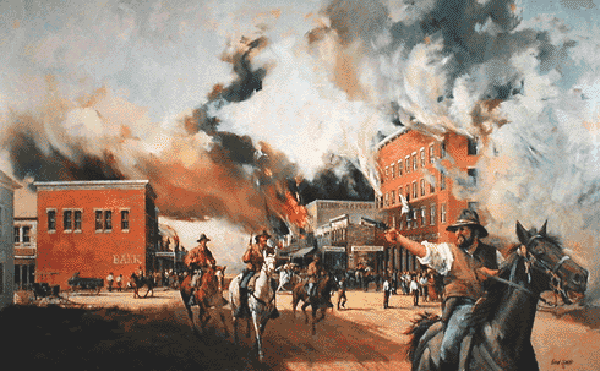
- Battle of Osawatomie, August 30, 1856.
- Marais des Cygnes Massacre, May 19, 1858.
- Osceola, population 3,000, was burned to the ground, 200 slaves were freed and 9 citizens executed without a trial, September 23, 1861.
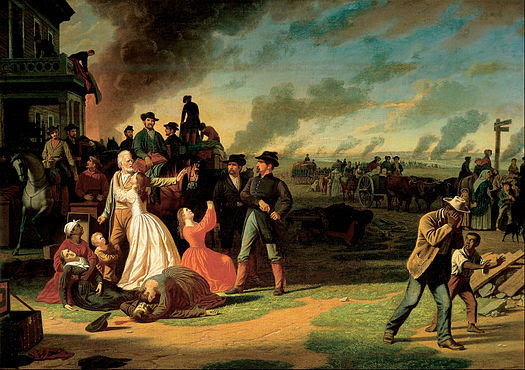
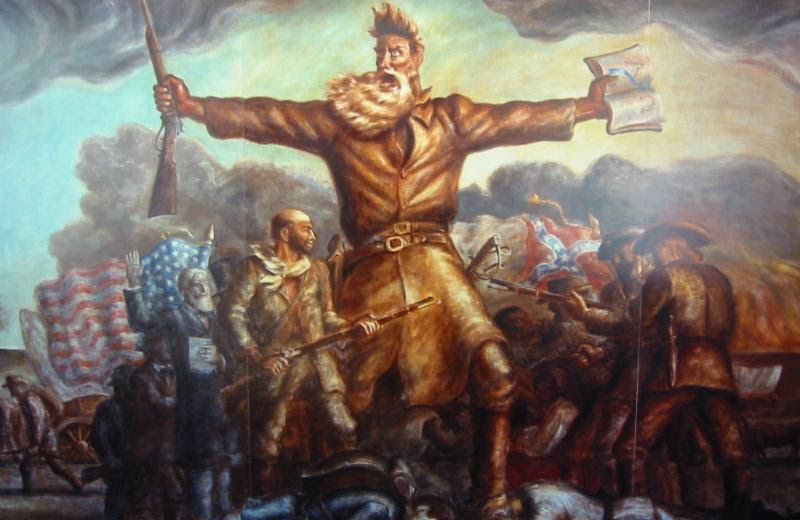 Abolitionist publisher Elijah Lovejoy was murdered by a pro-slavery mob.
At the end of a preaching service remembering the event, John Brown stood up in the back of the church and declared:
"Here, before God, in the presence of these witnesses, I consecrate my life to the destruction of slavery."
Brown was supported by many prominent leaders in the anti-slavery movement, such as Julia Ward Howe, author of the Battle Hymn of the Republic, and her husband, who received Brown into their home.
In October of 1855, John Brown went to fight slavery in Kansas.
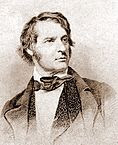
"Not in any common lust for power did this uncommon tragedy have its origin.
It is the rape of a virgin Territory, compelling it to the hateful embrace of slavery; and it may be clearly traced to a depraved desire for a new Slave State, hideous offspring of such a crime, in the hope of adding to the power of slavery in the National Government."
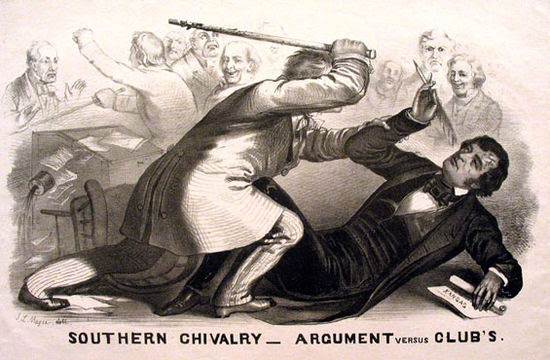 Two days later, Democrat Congressman Preston Brooks beat Senator Sumner nearly to death on the floor of the Senate.
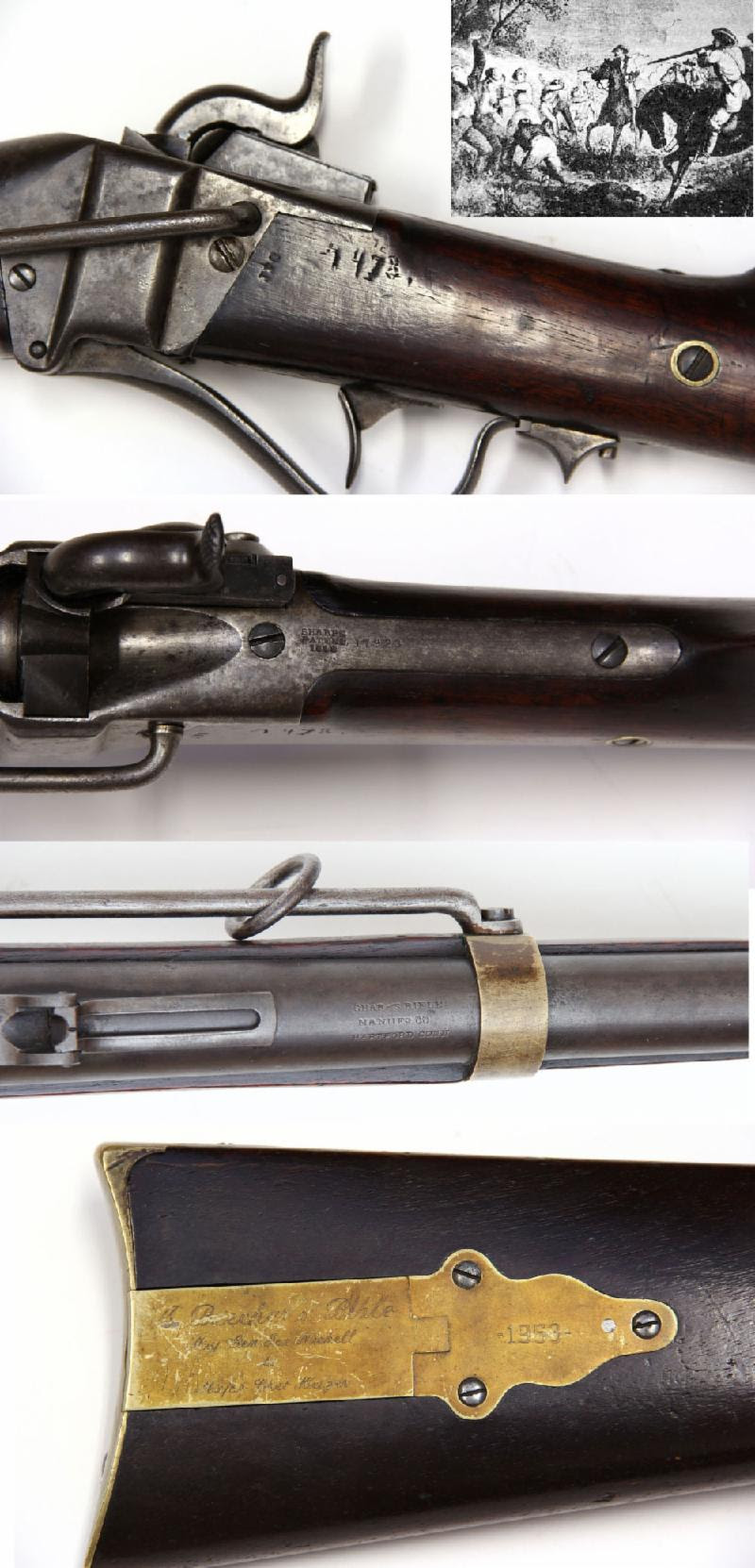 From 1854 to 1858, Henry Ward Beecher and his church bought hundreds of the new Sharps Rifles and shipped them to anti-slavery Free Soil supporters and abolitionist Republicans in Kansas.
These rifles had new 1850 patented innovations of breech-loading and self-priming, which offered quick loading, speed in firing, and accuracy in distance.
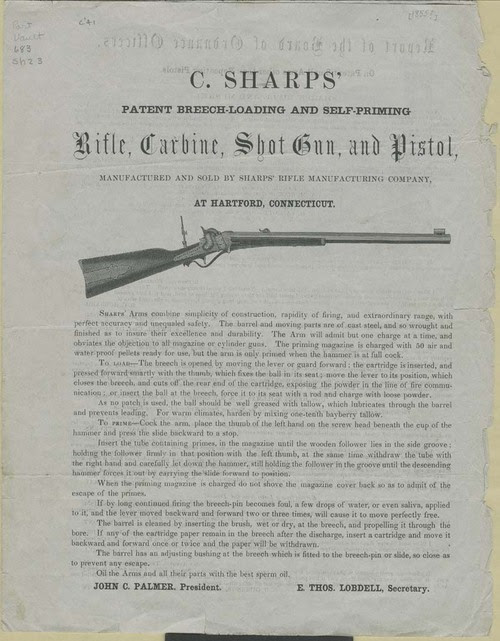 Recommending them as effective weapon to fight pro-slavery Democrats, The New York Tribune printed February 8, 1856, that Henry Ward Beecher:
"... believed that the Sharps Rifle was a truly moral agency, and that there was more moral power in one of those instruments, so far as the slaveholders of Kansas were concerned, than in a hundred Bibles ...
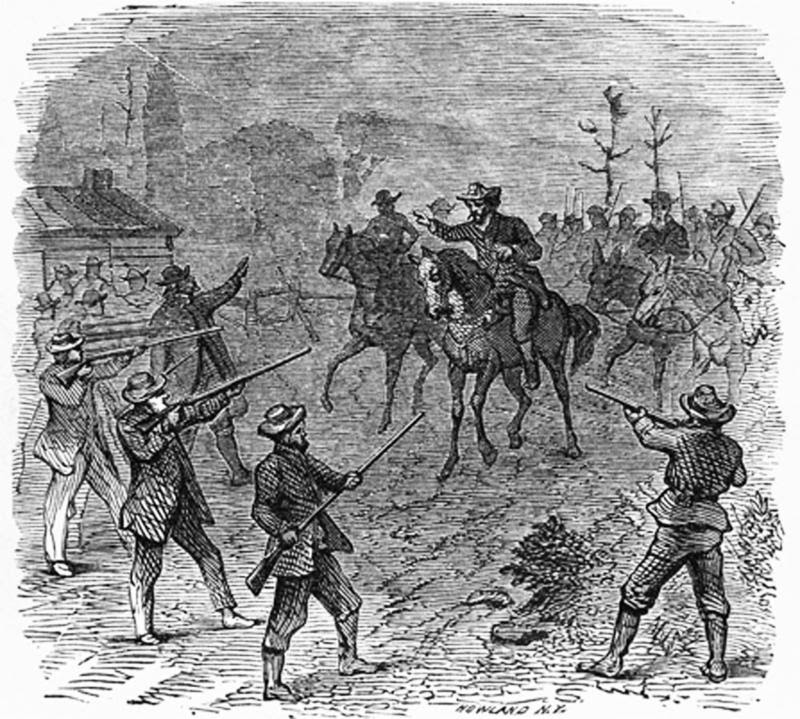 ... You might just as well ... read the Bible to Buffaloes as to those fellows who follow Atchison and Stringfellow; but they have a supreme respect for the logic that is embodied in Sharp's rifle."
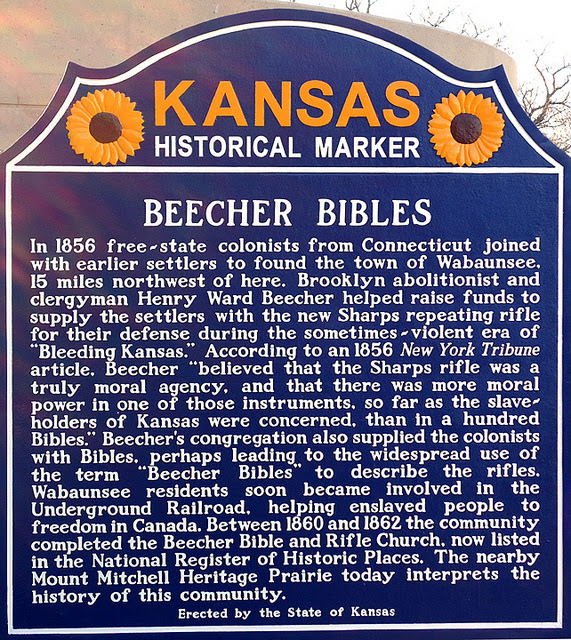 The Sharps Rifle soon became known as a "Beecher's Bible."
As Federal and State authorities forbade shipping arms to the region, rifles were packed in wooden crates marked as "Books."
When pro-slavery Democrats intercepted a case and took the guns, Beecher began to personally pass out rifles to abolitionist settlers who were headed to Kansas.
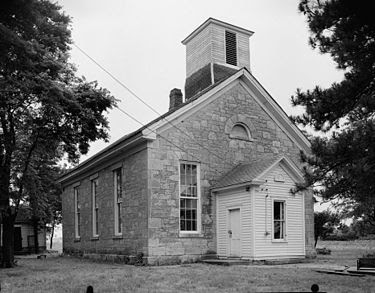
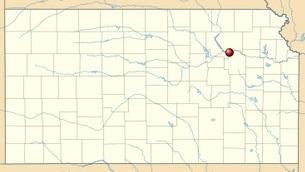 In 1855, seventy settlers founded a town in northeast Kansas named Wabaunsee, also called New Haven or the "Beecher Rifle Colony."
It became a stop of the Underground Railway for escaped slaves.
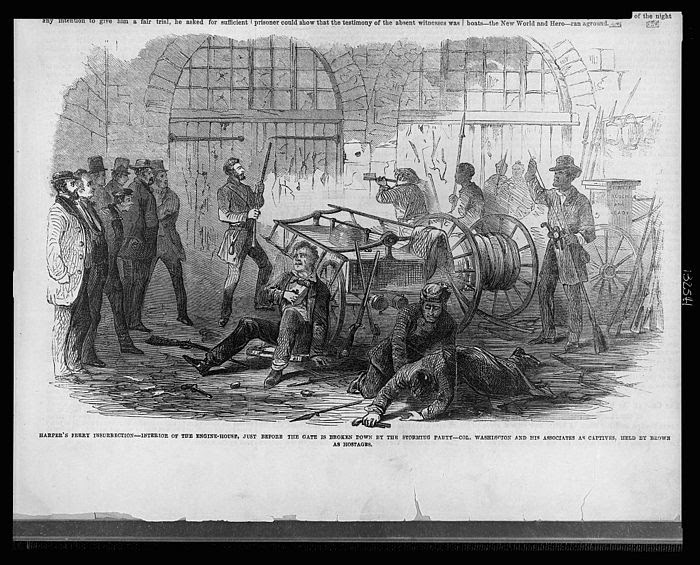 On October 16, 1859, John Brown led an ill-conceived attack on Harpers Ferry Armory, killing four people and wounding nine, having convinced himself that this would somehow start a slave uprising.
He was captured U.S. Marines led by Union Army Colonel Robert E. Lee and First Lieutenant J.E.B. Stuart.
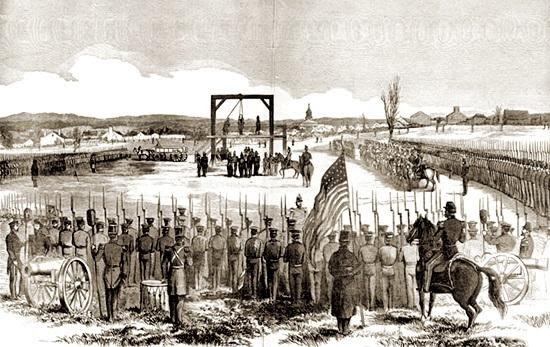 On December 2, 1859, John Brown was hung, being hailed as a martyr by the abolitionist movement.
Louisa May Alcott, author of Little Women, labeled him "Saint John the Just."
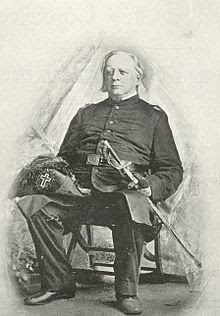
Just as during Republican Frederick Douglass helped recruit for the 54th Massachusetts Infantry - the Union's first black regiment, Henry War Beecher helped recruit and equip a volunteer Union infantry regiment - New York National Guard's 13th Regiment.
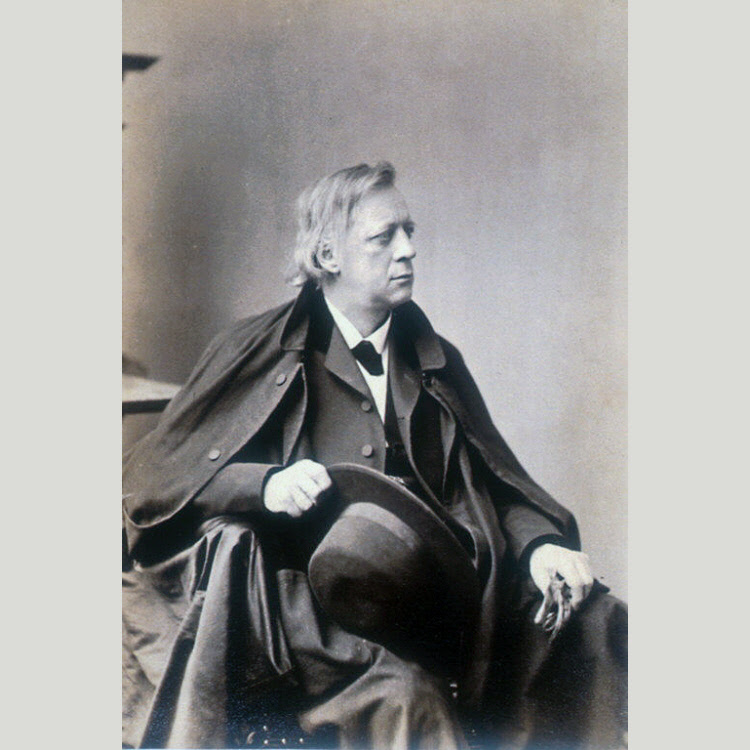 He was largely responsible for pressuring Republican President Lincoln to issue the Emancipation Proclamation, January 1, 1863.
When Union forces retook Fort Sumter in 1865, President Abraham Lincoln selected Henry Ward Beecher to give the speech commemorating the event.
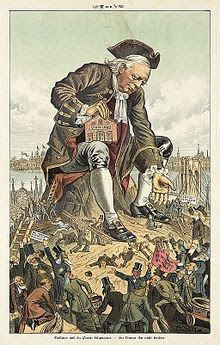 Immensely popular, Beecher was viewed as second only to Lincoln in shaping post-war America's public opinion.
Henry Ward Beecher stated:
"I educated myself to speak ... my moral convictions; and though, in later days, it has carried me through places where there were some batterings and bruisings, yet I have been supremely grateful that I was led to adopt this course ...
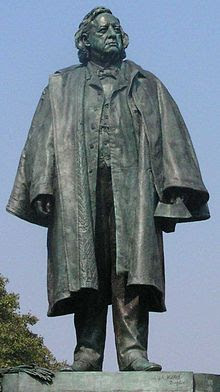 ... I would rather speak the truth to ten men than blandishments and lying to a million.
Try it, ye who think there is nothing in it!
Try what it is to speak with God behind you,--to speak so as to be only the arrow in the bow which the Almighty draws."
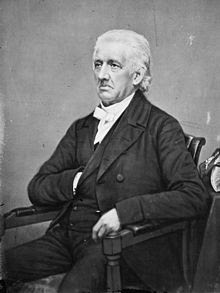 In 1833, Lyman debated for 18 days in a row at Lane Theological Seminary in favor of ending slavery.
Pro-slavery Democrats from Kentucky threatened to burn the campus down.
Lyman Beecher died JANUARY 10, 1863.
He was a renowned New England clergyman who defended the doctrine of the Trinity, thus curtailing the spread of Unitarianism.
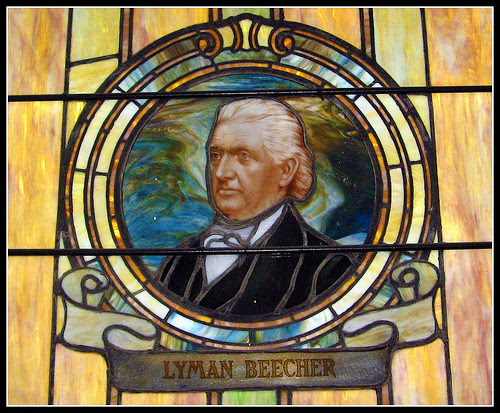
"Intemperance is the sin of our land, and ... is coming in upon us like a flood ...
If anything shall defeat the hopes of the world, which hand upon our experiment of civil liberty, it is that river of fire which is rolling through the land, destroying the vital air and extending around an atmosphere of death."
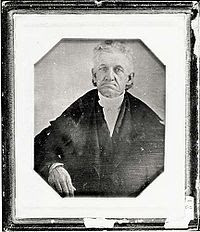 In his Plea for the West, 1835, Lyman Beecher wrote:
"If this nation is, in the providence of God, destined to lead the way in the moral and political emancipation of the world, it is time she understood her high calling, and were harnessed for the work.
For mighty causes, like floods from distant mountains, are rushing with accumulating power to their consummation of good or evil."
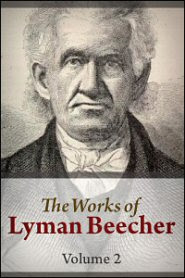
In The Spirit of the Pilgrims, 1831, Lyman Beecher wrote:
"The Government of God is the only government which will hold society against depravity within and temptation without."
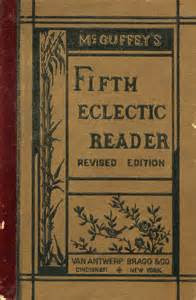
Lyman Beecher was quoted in McGuffey's Eclectic Sixth Reader, 1907:
"While most nations trace their origin to barbarians, the foundations of our nation were laid by civilized men, by Christians."
Download as PDF ...
--
American Minute posts brought to you by American Priorities 501(c)3.
American Minute is a registered trademark of William J. Federer. Permission granted to forward, reprint, or duplicate.
Fair Use Disclaimer (17 U.S. Code § 107): The above work is provided for not-for-profit educational purposes, free of charge, add free, and noncommercial. All images, text, excerpts and quotations included therein are for the purposes of teaching, scholarship, research, criticism, comment, and news reporting.